

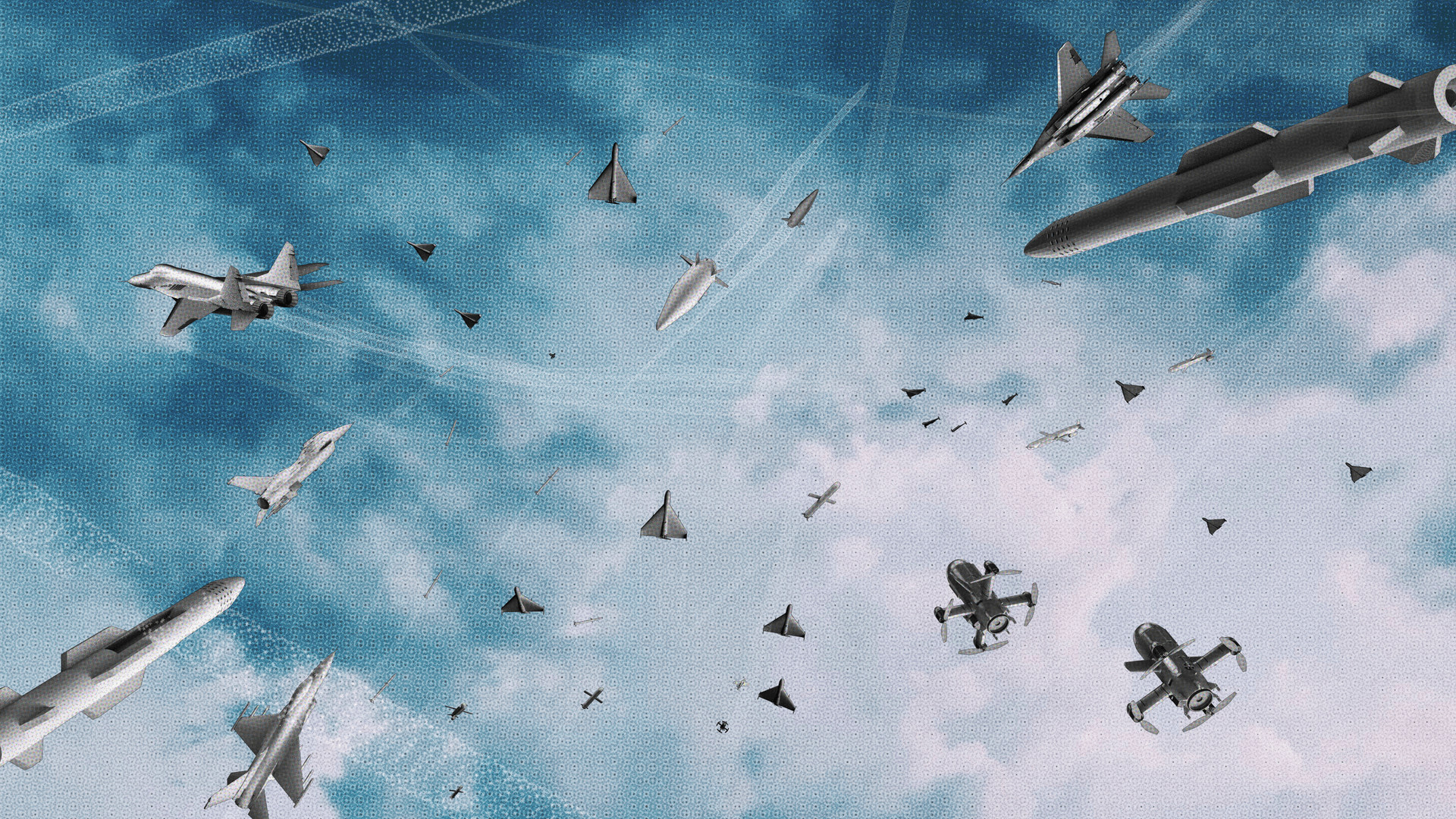
Ukraine’s air defense campaign represents the most intensive real-world stress test of integrated air defense in modern warfare. For four years, Ukrainian forces have defended cities, bases, and critical infrastructure against continuous waves of missiles and drones at a scale few modern militaries have experienced. Under constant pressure, they have adapted in real time, stretching limited stocks of interceptors, integrating new Western systems, and innovating cost-effective ways to defend against mass attacks.
This report, produced in partnership with the Colonel Yevhen Konovalets Military School, examines how Ukraine built, adapted, and sustained its air defense system since the beginning of Russia’s full-scale invasion. Drawing on operational experience, interviews with air defense personnel, and open-source data, it traces the evolution of Ukraine’s air defense from fragmented legacy systems to a layered, adaptive architecture operating under extreme resource constraints.
Rather than treating air defense as a collection of individual platforms, the report analyzes it as a living system shaped by throughput limits, interception economics, command-and-control resilience, and the ability to recover and reconfigure quickly. Ukraine’s experience offers rare insight into what air defense looks like in an industrial-scale war where the attacker can consistently generate more threats than the defender can afford to intercept.
Key themes and insights include:
— The shift from measuring air defense success by interception rates to managing system throughput and sustainability under wave-based attacks
— How Russia evolved from early attempts at air dominance to mass combined missile-drone strikes aimed at long-term attrition
— The role of layered defense, integrating legacy Soviet systems, Western SAMs, short-range guns, electronic warfare, interceptor drones, and civilian sensor networks
— The emergence of interceptor scarcity as an operational constraint, forcing strict prioritization and selective protection rather than uniform coverage
— Why resilience — recovery, dispersion, redundancy, and adaptation — matters as much as performance
The lessons in Holding Back the Sky are directly relevant for Ukraine’s partners and for any country preparing to defend against sustained, high-volume aerial threats. They offer practical, combat-tested insights for planners, policymakers, and industry leaders working to build air defenses that can endure, adapt, and protect.